Set sail on the legendary Blue Danube on a river cruise and explore the heart of Europe. This unforgettable adventure connects you to historic cities, grand architecture, and vibrant culture—all with a perfect mix of old-world charm and modern comfort. Visit the spiritual heart of Hungary, stroll through the fairytale towns of Dürnstein and Bratislava, and admire the baroque beauty of Linz, Budapest, and Vienna. Enjoy enriching experiences onboard, from a live classical quartet in Vienna to an authentic Hungarian folklore show in Budapest—all from the comfort of your elegant river ship. Let the Danube River lead you through Europe’s most treasured cultural landscapes on this remarkable journey.
Why You’ll Enjoy This Danube River Cruise:
♦ Discover the fascinating Esztergom Basilica and Slovakian capital, Bratislava with its 17th century castle and old town.
♦ Explore Dürnstein, famous for its ice blue tower and the castle where Richard the Lionheart was imprisoned.
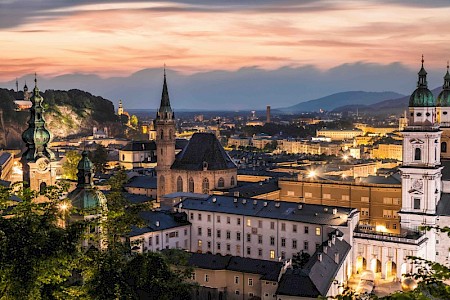
♦ Visit the charming baroque town of Linz, or the main sights of Salzburg such as the Hohensalzburg fortress, the Hellbrunn Palace and the gardens of the Mirabell Palace.
♦ See Vienna’s cultural sights, including St. Stephen’s Cathedral and the colossal Hofburg, and experience a guided tour of Budapest and its ancient Castle Hill, with views of the iconic Parliament Building.
♦ Enjoy our live classical quartet recital with views of Vienna and a Hungarian folklore show in Budapest on board the ship.
Itinerary
Day 1 - Arrive Budapest, Hungary
Upon arrival in Budapest, you will be met and transferred to your hotel for checkin.* The remainder of the day is yours to discover the beauty of Budapest at your own pace before meeting with your Tour Director at 5:00pm for an orientation meeting.
*Depending on your arrival time your room may not be ready. Your Cruise Concierge can highlight some activities.
Day 2 - Budapest
Breakfast this morning before we make our way to the M/S Geoffrey Chaucer for embarkation. Your attentive crew will greet you as you board, helping you get comfortable and acquainted with this exceptional floating hotel. There’s something special about the anticipation that comes with the start of a cruise, and over an excellent dinner in the elegant restaurant, you’ll likely find yourself and your fellow passengers already discussing the adventures to come. (B,D)
Day 3 - Esztergom
While you sleep, the ship travels upstream to Esztergom, one of Hungary’s most ancient towns—a medieval royal capital that now serves as the seat of the country’s archbishop. During your guided tour, you’ll visit the renowned neoclassical basilica that overlooks the Danube at the Slovakian border, home to one of the world’s largest altarpieces and an impressive collection of precious religious artifacts.
The castle is equally compelling. It served as the seat of government until the Ottoman invasion of the 16th century, and below it you’ll find numerous historic churches filled with the beautiful sounds of choral music. This is provincial Hungary at its finest, remarkably preserved since the Habsburg era. Over your first lunch aboard, the ship pulls away from Esztergom, offering you a fascinating chance to observe the contrasting landscapes, towns, and villages of Hungary on one side of the river and Slovakia on the other. (B,L,D)
Day 4 - Bratislava, Slovakia
This morning brings a guided tour of Bratislava, Slovakia’s rapidly evolving capital. After decades obscured by Communist uniformity, the city has revived the grandeur of its imperial heritage through careful restoration of its Old Town.
You’ll see the sole surviving gate from the original city fortifications, the Neo-Renaissance Old Opera House, and St. Martin’s Cathedral—a 15th-century Gothic church where coronations once took place. The tour also includes the Classicist Primate’s Palace and the Main Square, where the former town hall now operates as a city history museum with a tower offering excellent views. The imposing 17th-century fortress provides sweeping panoramas across the Danube, while the Primatial Palace showcases its stunning Hall of Mirrors and rare collection of 17th-century English tapestries.
The city has a playful spirit reflected in its streets. If you prefer exploring independently, you’ll encounter whimsical touches throughout—quirky signage and imaginative sculptures like Čumil, a bronze figure emerging from a manhole, and the cheerful Schöne Náci. Afterward, settle into one of the many cafés for freshly ground coffee or homemade lemonade.
This afternoon, the ship enters Lower Austria, a tranquil, pastoral region known for producing some of the country’s finest wines. By now, everyday worries feel far away as you take in the shifting scenery along the riverbanks—children at play, young couples walking arm in arm just as generations have done before, winemakers tending their vines, and cobblestone quaysides framed by half-timbered buildings.
You’ll watch as the captain expertly guides the ship along the calm river and through the locks, whose workings remain endlessly captivating, as you continue toward Dürnstein. (B,L,D)
Day 5 - Dürnstein & Melk
Dürnstein is best known for the ice-blue tower of its abbey rising above the town and the castle where Richard the Lionheart was imprisoned in 1192 after being shipwrecked on his return from the Crusades. This morning’s guided walking tour takes you deeper into this memorable riverside town.
You’ll stroll the narrow pedestrian streets to the center of Dürnstein, where the Town Hall stands. Built in 1547, this late Gothic structure was elegantly renovated in Renaissance style in 1563. Its courtyard, with its graceful stairway, makes an ideal spot for photographs amid the historic surroundings.
The Krems Gate, once called the Steiner Gate, marks the eastern entrance to the city. This impressive gateway features a striking four-story square tower from the 15th century, showcasing the town’s architectural legacy. The sturdy city wall extends south toward the Danube and north toward the evocative ruins. Today, the tower serves as a private residence.
For those seeking more activity, there’s an optional hike up to Dürnstein Castle, perched on a rocky outcrop high above the river. The steep climb isn’t easy, but those who make the ascent are rewarded with beautiful views of the river valley and town below. At the summit, you can wander through the castle ruins where England’s legendary king was held captive—easy to picture Richard the Lionheart frustrated and far from home, waiting for his family to raise the ransom. This hike requires good mobility and proper footwear.
After lunch, you’ll visit the remarkable Melk Abbey. Nothing quite prepares you for the first glimpse of this enormous honey-colored structure standing majestically above the surrounding countryside. Originally a castle, it was given to the Benedictine Order in the 11th century and, though rebuilt in Baroque style during the 18th century, has functioned as both a monastic school and monastery ever since.
The abbey is celebrated for its 214-yard Emperor’s Gallery lined with portraits, its beautifully appointed rooms, and an ornate library. Following the tour, you can explore the grounds or walk back to the ship through the charming old town, where buildings date to the 15th century. Once everyone’s back aboard, dinner is served as the ship completes the final stretch of its upstream journey through the picturesque Nibelungengau, immortalized in Wagner’s music. (B,L,D)
Day 6 - Salzburg or Linz
Today, visit Linz or Salzburg for a guided walking tour and time to explore at leisure.
Linz
Upon reaching Linz, you can choose to stay in the city for a guided walking tour of its lovely Baroque old town. At its center, you’ll find one of Austria’s finest squares, framed by grand pastel-colored buildings and dominated by an impressive Trinity Column in white marble topped with a gilded sunburst. There’s also the fortress-like castle built above the city by Emperor Friedrich III, now a museum with an excellent collection of 19th and 20th-century art.
The afternoon is yours to explore as you wish. You might take a ride on the Pöstlingbergbahn, a distinctive narrow-gauge electric railway known as the “mountain tramway” that connects Linz’s main square with the Pöstlingberg district. As Europe’s steepest adhesion railway, it offers spectacular views as it climbs past the Danube and the Ars Electronica Center toward a natural retreat on the city’s edge. At the top, you can visit the pilgrimage basilica, take in the views of Linz from the observation platform, check out the local zoo, and more.
Alternatively, Linz has several intriguing museums worth visiting. The Ars Electronica Center serves as the city’s museum of the future, presenting cutting-edge technology and forward-thinking media arts. The Lentos Kunstmuseum features modern and contemporary art from the 19th century onward, including works from classical modernism (Klimt, Schiele, Kokoschka) and the Expressionist movement.
Salzburg
Alternatively, take a drive to Salzburg, once an independent state whose archbishops transformed it into one of the most cultured cities north of the Alps. The skyline is dominated by the Hohensalzburg, one of Europe’s largest stone fortresses, while below its walls, church domes and spires rise from the delightful Altstadt, or Old Town. The city also boasts the magnificent Hellbrunn Palace and the elegant formal gardens of Mirabell Palace—a treat for anyone who loves horticulture.
This morning, you’ll explore some of the city’s main attractions with an expert local guide, then have free time for lunch and independent exploration. Throughout the city, you’ll encounter reminders of its most famous resident, Mozart, who played the harpsichord at age three, composed simple pieces at five, and wrote his first opera at eleven.
You’ll return to the ship for another excellent dinner. (B,L,D)
Day 7 - Vienna
For 200 years until World War I, Vienna served as Europe’s cultural capital, and many of the grand buildings, galleries, aristocratic palaces, and splendid churches you’ll see today were built to reflect its imperial status. The city’s most iconic landmark is the stunning Saint Stephen’s Cathedral, whose striking multicolored roof and towering Gothic South Tower dominate the skyline.
There’s also the massive Hofburg, the former royal court that now houses several museums, the Crown Jewels, the Spanish Riding School, and the performance venue for the Vienna Boys’ Choir. Inside, you’ll find the opulent Imperial Apartments and an extraordinary collection of Holy Roman Empire relics, including what’s said to be Charlemagne’s own sabre. Just across the street sits the Kunsthistorisches Museum, home to the world’s fourth-largest painting collection.
This morning, you’ll tour with a local guide who’ll explain why Vienna ranks among Europe’s greatest capitals—the seat of the Habsburg emperors and home to some of the world’s finest classical composers, including Beethoven, Brahms, Mozart, and an entire family of Strausses. After a scenic coach tour along the Ringstrasse, the famous boulevard built where the city walls once stood and lined with many of the most important sights, you can either continue on foot through the old town or set off on your own.
During the afternoon, you’re free to explore at your own pace. You might stroll through the Prater, known for its giant Ferris wheel featured in several Cold War spy films. Or visit Schönbrunn Palace, a former royal residence now home to world-class museums and galleries. Perhaps simply wander Vienna’s atmospheric side streets or settle into one of the charming coffee houses for coffee and a slice of delicious Sachertorte.
This evening offers something special. Not only will you enjoy the indulgent Chef’s Dinner, but there’s also a live musical performance on board. After this memorable meal, relax and take in an intimate classical recital. Hearing this beautiful music in Vienna—where it was created—is the perfect finishing touch. (B,L,D)
Day 8 - Budapest, Hungary
Enjoy a relaxed morning as the ship glides through Hungary’s tranquil countryside toward Budapest. After breakfast, head up to the sun deck for spectacular river views as you cruise along the “Danube Bend,” passing historic and scenic towns like Visegrad and Szentendre. Castle ruins, churches, charming hillside houses, and dense forests are mirrored in the river’s waters. Settle in with a book on the sun deck or simply recline and let the gentle breezes ease you into a peaceful nap.
After lunch, you’ll embark on a sightseeing tour of this captivating city, which truly earns its reputation as the “Pearl of the Danube.”
The twin cities of Buda, built around a hilltop fortress, and Pest, with its broad boulevards, have been contested throughout the centuries. The Ottomans ruled here for 150 years before their expulsion in the late 17th century, but their influence endures in the many thermal baths fed by hot springs—giving Budapest its other nickname, the “City of Spas.”
Following Ottoman rule, Budapest became an imperial city within the Habsburg Empire, attracting significant cultural and commercial prosperity. Castle Hill captures Budapest in miniature: two churches, seven museums, and a theater nestled among streets and squares with their own distinctive character, plus dramatic views across the river to the magnificent neo-Gothic Parliament Building.
This afternoon, you have two options:
The panoramic coach tour takes you past some of Budapest’s famous landmarks, including the Opera House, Gellert Baths, Chain Bridge, and Parliament Building, with stops for photos and exploration at Heroes’ Square and Buda Castle.
Alternatively, the active tour begins with a coach ride to the Castle District. From there, you’ll take elevators up to the castle terraces for a guided walking tour of the castle area and Fisherman’s Bastion. You’ll then have free time to explore before returning to the coach for the transfer back to the ship. This tour involves uneven terrain and considerable walking, so it’s recommended only for those comfortable with moderate activity levels.
This evening’s dinner concludes with a Hungarian folklore show, giving you a chance to say farewell to your fellow travelers and reflect on all the inspiring places, sights, and sounds you’ve experienced on this truly imperial cruise. (B,L,D)
Day 9 - Depart Budapest
After breakfast, It’s time to bid farewell to your crew and transfer to the airport to begin your journey home. (B)